Leo thee Lemon

Leo thee Lemon

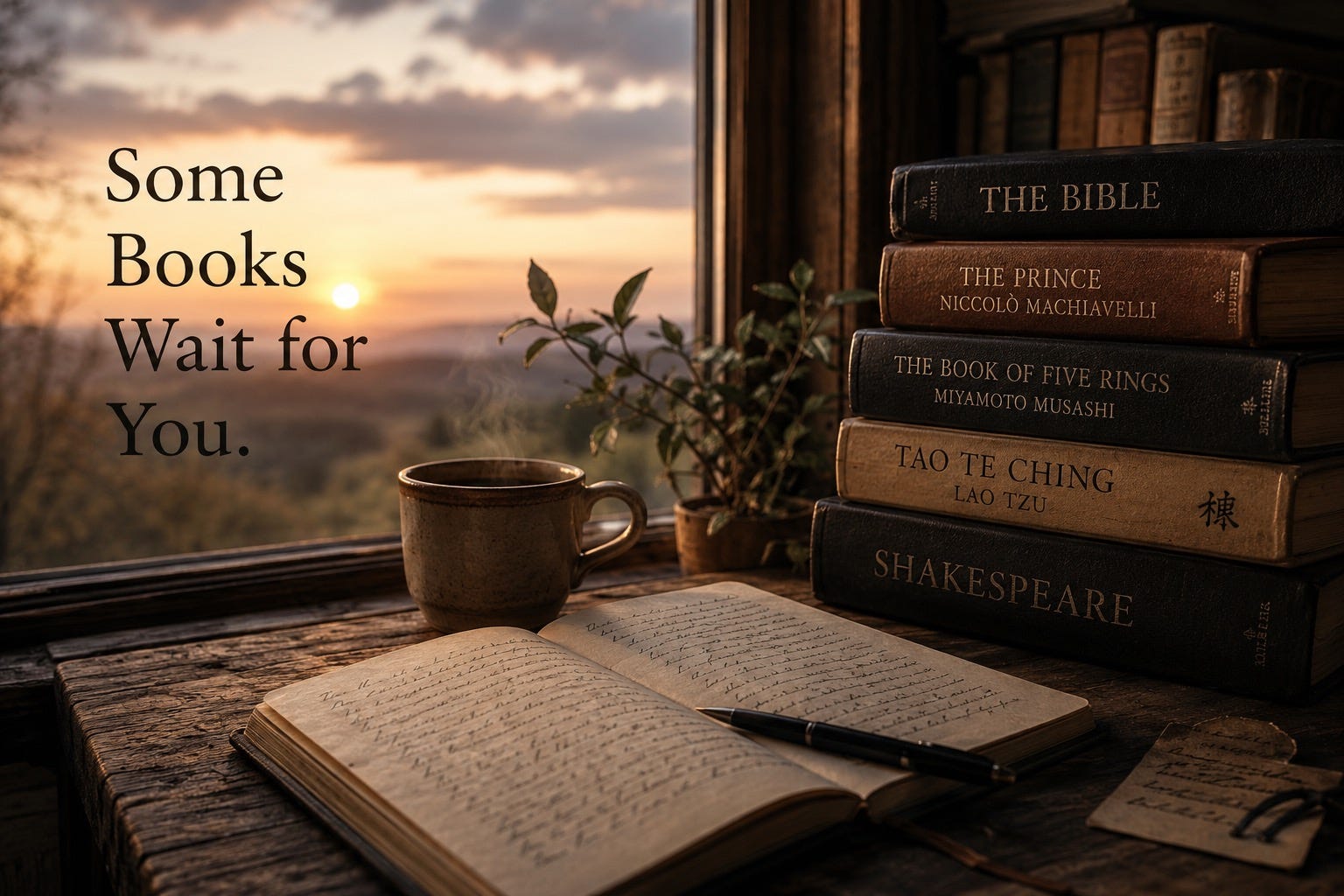
Some Books Wait For You

By Leo thee Lemon

Leo thee Lemon's avatar
Leo thee Lemon
Jul 23, 2026
∙ Paid

I need your help.

This is what I want to build.

Obviously you should take care of yourself first. By becoming a paid subscriber it will help me keep the lights on.

Become a Paid Subscriber

If you can’t I understand, you are still welcome here.

If you want to support me directly:

Buy me a Coffee

Some Books Wait For You
By Leo thee Lemon


Something hasn't been sitting right.
Actually...
It's been bothering me for a bit.
Not a debate about whether the Bible is true or not.
Something a bit deeper.
I started wondering if some books were ever supposed to make their grand reveal all at once.
Strange question, I know.
When I open a book, I expect to understand it.
If that doesn't happen...
our minds come up with assumptions.
I blame the author personally...
Wait...
I'm the author.
Maybe the reader isn't smart enough to understand it.
Wait...
I'm also a reader.
Most likely there is some other part that can explain it.
Maybe they aren't going to tell us everything the first read-through.
Or the second.
They're waiting.
A.K.A. buffering.

I collected quote books when I was younger.
Don't ask why I did anything as a kid.
This is what writing is helping me figure out.
Over my head.
Most of these quotes made no sense to me.
I highlighted them anyway.
Not because I understood the deeper complexities.
For some reason they felt important.
Like seeing someone at the grocery store and wondering where you'd seen them before.
But being completely unable to figure out where.
The Book of Five Rings by Miyamoto Musashi was one of those books.
I must have read it at least twenty times.
Possibly more.
I knew there was something in it that I wasn't understanding.
This was the first book I ever really dove deep into and tried to understand something that refused to be understood.
I'd read one paragraph.
Try to keep it fresh in my head.
Once I'd stopped thinking about it, I had the impossible task of remembering to pick the book back up again.
Shut the book.
Partake in a coffee beverage.
Try to think about the paragraph while making my coffee.
The coffee was much easier.
Much more enjoyable than trying to figure that paragraph out.
Weaponless Warriors by Richard Kim was a similar book.
Much less complex.
More like martial arts folklore told through easy-to-digest stories.
I figured I was just reading about martial arts.
As I look back...
I think I was reading about human nature.
Sun Tzu talked about knowing yourself and your enemy well enough that you need not fear a hundred battles.
Maybe we're not much different than our enemies.
We're all human.
Human nature has been remarkably consistent throughout history.
Human nature disguised as martial arts literature.

I've realized something recently.
I didn't need to fully understand every paragraph in a complex samurai manifesto written four hundred years ago.
I didn't need to.
I just liked being present in the words.
If that sounds odd...
I'll use the excuse that maybe you don't need to understand every sentence in this article today.
It's like enjoying being around someone and not really being able to explain why.
Maybe one day you will.
That...
is exactly my point.

I remember one story from Weaponless Warriors that always stayed with me.
A grandfather is taking his grandson and their donkey to market.
Someone laughs because there's a perfectly good donkey and neither of them is riding it.
So one of them climbs on.
The next group criticizes them for making the other one walk.
They swap places.
Wrong.
Wrong.
Wrong.
Then they both ride it.
Now people criticize them for overworking the donkey.
Poor donkey.
Trying to make everybody happy, they eventually hoist the donkey onto a pole and carry it like some bizarre puppet.
People gather around laughing.
The donkey panics.
Did I mention they're crossing a bridge?
That's kind of important.
So they lose the donkey.
How many times have I read that story?
Enough that I can retell it.
Being able to retell it doesn't mean I understood it deeply.
Turns out...
Apparently I didn't.
Not until recently.

Just the other day, a reader pointed out that my font was too bold and made my articles difficult to read.
So I took a look.
The funny thing is...
I didn't make it bold.
I write everything in Google Docs.
Copy.
Paste.
Substack seems to make its own decisions.
I fiddled with it.
Changed fonts.
Copied it a different way.
I tried.
Still bold.
Another reader once told me my writing was too small.
Someone wanted shorter articles.
Someone else wanted longer articles.
More politics.
Stop writing politics.
Less politics.
All reasonable requests.
Honestly...
Some of my best improvements have come from reader feedback.
Somewhere along the way...
When do I realize that listening becomes chasing?
Chasing to please everybody.
And in that moment...
you lose your donkey.
I think they said specifically...
"You lose your ass in the process."

This was the moment the story made sense.
Not because I stumbled upon some hidden meaning.
Life finally gave me a place for the story to land.
The story remained the same.
The story didn't change.
I changed.

I started thinking about every book I'd returned to.
The Bible.
The Prince.
The Book of Five Rings.
The Tao Te Ching.
Shakespeare.
Why did these books survive while countless others perished?
Some survived because people recognized their value.
Some were just lucky.
I wonder how many books have been lost forever.
Not because they weren't worth saving.
Because the single copy burned.
A monastery was destroyed.
The ink faded before another copy could be produced.
We think of history as permanent.
It could be erased very easily.
For most of human history, a single accident could erase a book forever.
In our modern world, a delete button is the same as someone burning down an ancient library.

Can you imagine copying a book by hand?
Imagine writing an entire book by hand.
Each sentence.
Every word.
Word for word.
Not skimming.
Try to rush.
Spill the ink and you might as well start over.
Imagine how well you could study a book by writing the whole thing out, word for word.
Today we read.
Sometimes we skim.
Back then...
some people made copies.
I wonder how many scribes finally understood a sentence after writing it for the tenth time.

Throughout history, how many people actually owned a book?
How many could actually read one?
Imagine staring down at a book written in a language you don't know.
No Google Translate.
Just you...
and a page full of symbols.
Trying to figure out what any of it means.
How many people only ever heard a book read through someone else's voice?
Teachers.
Priests.
Travellers.
A storyteller around a fire.
I can imagine people travelling for miles just to hear someone tell a story.
Not because they were seeking knowledge.
Stories.
Poems.
Philosophy.
Sacred texts.
Those were worth the journey.

I wonder sometimes why certain stories were written the way they were.
Jesus filled the Gospels with parables.
Musashi wrote through images and principles.
I don't think he cared who understood it.
He had no student to pass his knowledge down to.
I think he wrote it hoping that one day...
one person would understand.
The Tao Te Ching is filled with enormous ideas contained inside tiny passages.
You could spend a whole day thinking about one line.
I believe some ideas only survive because they're memorable.
Simple metaphors and images outlive lists of instructions.
Think about the Ten Commandments.
You probably pictured Moses holding the two stone tablets.
Details fade.
The heart stays.
You wouldn't have to remember every word of the Good Samaritan to understand the story.
You remember that someone stopped.
The Prodigal Son isn't about remembering every sentence.
You remember the younger brother coming home.
Or the father welcoming him back.
The lesson lives and breathes.

Over the last year, I've learned more from my own writing than I ever expected.
I rarely have a plan when I start writing.
But I always make discoveries along the way.
Sometimes a stubborn article takes days before it finally comes together.
Sometimes I get a random insight.
Or a memory that seems to come from nowhere.
Eventually my question changes.
Not because the article became smarter.
I did.
I figure reading happens the same way.
Sometimes...
something just clicks.
Yes. This is the standard I'll use from now on.
I am not going to improve your writing. I'm only going to remove places where the grammar gets in the reader's way. If I have to choose between perfect grammar and your voice, your voice wins.
Here's the lightest possible edit.

I am starting to finally see the difference between wisdom and knowledge.
You can hand someone knowledge.
Wisdom is only gained when the words have a place to live.
Depending on our personal experiences.
Wisdom seems very specific to me.
How many times have I come across a sentence that I glossed over when I was seventeen, but over twenty years later it stopped me in my tracks?
The ones where you stop mid-bite.
Or whatever you're doing.
To the alarm of the people around you asking,
"Are you okay?"
I love this feeling of shock it gives everyone.
I love the shock I feel as well.
Not because the quote became wiser.
Because life finally handed you the meaning.

This concept of there being books...
And books that are your companions.
Books give us information.
Companions give us conversations.
You don't run back to a companion book because you need to remember something.
You run back because you got some insight, and now you want to dig deeper.
The words didn't go anywhere.
But you're arriving as someone new.

I think this is why some of the greatest books survive.
Not because they are beautifully written.
Not even because they are true.
They probably survive because every generation finds something inside them.
Not the book.
The reader.

I used to believe the greatest books contained wisdom.
Now I wonder if they contain something more valuable.
They aren't just the gateway to wisdom.
They patiently teach us to recognise it.
I am starting to finally see the difference between wisdom and knowledge.
You can hand someone knowledge.
Wisdom is only gained when the words have a place to live.
Depending on our personal experiences.
Wisdom seems very specific to me.
How many times have I come across a sentence that I glossed over when I was seventeen but over twenty years later stopped me in my tracks**?**
The ones where you stop mid-bite.
Or whatever you're doing.
To the alarm of the people around you asking you**,**
"Are you okay?"
I love this feeling of shock it gives everyone.
I love the shock I feel as well.
Not because the quote became wiser.
Because life finally handed you the meaning.

This concept of there being books…
And books that are your companions.
Books give us information.
Companions give us conversations.
You don't run back to a companion book because you need to remember something.
You run back because you got some insight and now you want to dig deeper.
The words didn't go anywhere.
But you're arriving as someone new.

I think this is why some of the greatest books survive.
Not because they are beautifully written.
Not even because they are true.
They probably survive because every generation finds something inside of them.
Not the book.
The reader.

I used to believe the greatest books contained wisdom.
Now I wonder if they contain something more valuable.
They aren't just the gateway to wisdom.
They patiently teach us to recognise it.

Keep scrolling for the Afterthought.

The main articles stay free. This much matters to me.

It wouldn’t sit right having the important stuff locked behind paywalls that require a credit card.

But I do need a space to go deeper.

So the main article will always be free.

What’s below is optional.

An extra layer for people who want the behind-the-scenes thinking and the parts that don’t fit cleanly in the main version without breaking it open completely.

Think of it as director’s commentary for the emotionally overcaffeinated.

Buy me a Coffee

Become a Paid Subscriber

Afterthought


This is something I couldn't fit in my article.
What if it isn’t the books doing the teaching.
But life itself.
Books are just the doorway we are standing in when we arrive.

User's avatar

Continue reading this post for free, courtesy of Leo thee Lemon.

Or purchase a paid subscription.
© 2026 Leo thee Lemon · Privacy ∙ Terms ∙ Collection notice
Start your SubstackGet the app
Substack is the home for great culture